South Pacific · Puntarenas · Costa Rica
What Is Life in Dominical, Costa Rica Like?
Dominical is the surf heart of Costa Rica's South Pacific — a small, gritty beach town with one of the most consistent waves in Central America, anchoring the northern end of the Costa Ballena corridor.

What Dominical Actually Is
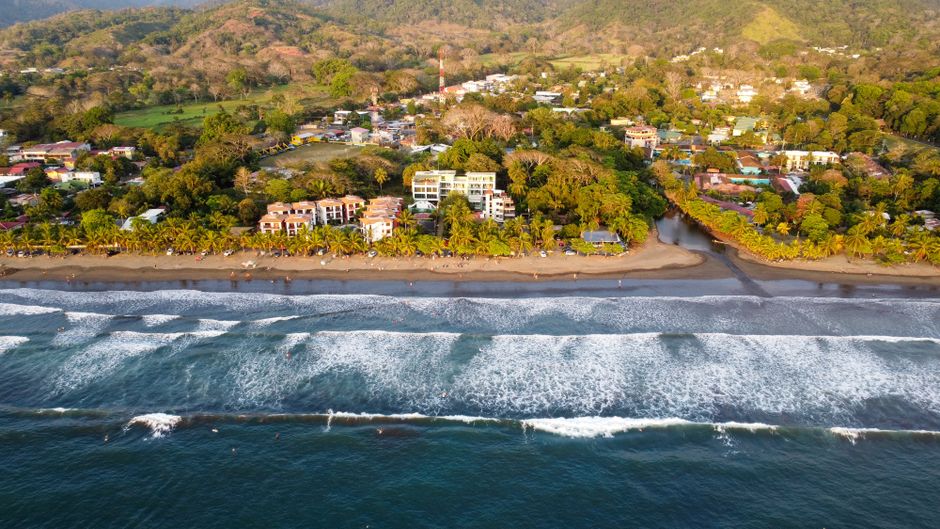
Dominical is a small beach town on Costa Rica's South Pacific, in the Puntarenas province, sitting at the northern end of the Costa Ballena corridor where the coast meets the mountains rising inland toward San Isidro del General. The town has a long history as a surf destination — surfers have been coming here since the 1970s, and the wave that breaks at the river mouth and along the main beach is one of the most consistent in Central America.
What Dominical is not: a polished beach resort, a town with developed tourist infrastructure, or a place that presents itself with the upscale character of Manuel Antonio or the international dining culture of Ojochal. The main strip is dusty in dry season and muddy in green season. The town functions on surf time and does not apologize for it.
What Dominical is: one of the more authentic beach towns in Costa Rica, with a long-term community of Costa Rican families and internationally diverse long-term expats who chose it precisely because of what it is not. The hillside neighborhoods — Escaleras, Dominicalito, Hatillo — carry a different, quieter residential character above the beach activity and offer some of the most dramatic ocean-view properties on the South Pacific.
Dominical sits at the junction of the Costanera Sur coastal highway and the road climbing over the mountains to San Isidro, making it a natural crossroads. It functions as part of a regional life shared with Uvita (fifteen minutes south) and Ojochal (thirty minutes south), and most long-term residents treat the three towns as a single connected area.
- Located in Osa canton, Puntarenas province, northern end of Costa Ballena
- One of the most consistent surf breaks in Central America
- Rougher infrastructure than larger beach towns — part of its character
- Hillside neighborhoods Escaleras, Dominicalito, and Hatillo carry different character than the beach strip
- Connected to Uvita and Ojochal as a single regional life
What Daily Life Looks Like
Daily life in Dominical depends entirely on which part of Dominical you live in. The beach strip and immediate surroundings are walkable and casual; the hillside neighborhoods require driving for almost everything; the rural inland properties are remote enough that town visits are scheduled trips rather than impulses.
For groceries, there is a small market in town that covers basics, but most residents do their main shopping in Uvita at BM Supermercado. The Saturday Uvita farmers market draws the wider regional community. For larger purchases, the trip over the mountains to San Isidro is about an hour.
Banking and pharmacies are in Uvita. Restaurants in Dominical are modest in price and number — a few well-regarded spots and a casual bar scene. The food culture is more casual than Ojochal's, with good daily-meal options but fewer special-occasion dining experiences.
The town wakes up early around the surf rhythm. Serious surfers are in the water at dawn. By mid-morning, the strip picks up activity. By evening, things quiet down significantly. Dominical is not a nightlife town.
Internet through fiber providers reaches the main town area. Hillside properties may have weaker connections — verifying signal at a specific address before committing matters. Mobile coverage is generally solid on the main road.
Pace is genuinely slow. Service efficiency expectations need to be adjusted. Tico time is the operating standard.
- Daily life depends on whether you live on the strip, in hillside neighborhoods, or rural inland
- Most groceries and broader services come from Uvita (~15 minutes south)
- Town wakes up early around surf rhythm; quiet after dark
- Fiber internet in populated areas; hillside properties may have weaker connections
- Larger purchases require trip to San Isidro del General over the mountains
- Pace is genuinely slow — service efficiency expectations need to be adjusted
Climate and Environment
Dominical has a wet tropical climate similar to Uvita and Ojochal. The dry season runs December through March; the green season May through November, with September and October typically the wettest months. Annual rainfall is significant, the landscape stays green most of the year, and the rains during peak green season can be intense — heavy afternoon and overnight downpours are common, sometimes lasting for days.
Heat is constant. Daytime temperatures regularly reach the high 80s and low 90s Fahrenheit. Humidity is high year-round. Most properties use air conditioning in at least the bedrooms. Without it, the hottest stretches are uncomfortable.
The Pacific here is the defining environmental feature. The wave at the river mouth — the one that put Dominical on the surf map — is produced by the same ocean conditions that generate strong currents across significant stretches of the beach. Dominical's ocean is beautiful and dangerous simultaneously. People drown here every year.
Wildlife is abundant. Sloths, monkeys, scarlet macaws, toucans, and a wide variety of birds inhabit the rainforest that begins directly behind the beach. Hillside neighborhoods like Escaleras and Dominicalito sit within forest habitat where wildlife is part of daily property life. The Hacienda Barú National Wildlife Refuge borders the area and adds habitat connectivity.
The rainforest environment creates ongoing construction challenges. Mold, mildew, humidity, and the tropical elements affect structures continuously. Maintenance costs are real and ongoing.
Water supply and electricity are generally reliable on the main road. Hillside properties may experience more frequent outages during heavy rains.
- Wet tropical climate; September and October typically wettest
- Pacific produces consistent year-round surf — world-known wave at the river mouth
- Strong currents make swimming dangerous along significant stretches of beach
- Wildlife abundant — sloths, monkeys, macaws, toucans routine
- Direct rainforest access from hillside neighborhoods (Escaleras, Dominicalito, Hatillo)
- Rainforest humidity affects construction, vehicles, electronics continuously
Cost of Living Reality
Dominical is generally less expensive than Manuel Antonio or Tamarindo, comparable to Uvita and Ojochal. Cost depends heavily on whether you live local or attempt a foreign lifestyle.
Imported goods carry standard import duties. Local produce, fish, basic services, and labor are affordable. Restaurants in Dominical are mostly modest in price, with a small selection of higher-end places. The food culture is more casual than Ojochal's.
Housing varies by location. Beach-adjacent properties in town are affordable but exposed to noise and the busier daily rhythm. Hillside properties in Escaleras, Dominicalito, and Hatillo carry premiums for ocean views and quiet, with significant variation by elevation, access, and quality. Long-term rentals are widely available and meaningfully cheaper during green season. Owning property in this rainforest climate means continuous maintenance.
Utilities are typical for coastal Costa Rica. Electricity is expensive; AC bills accumulate fast if you run it constantly. Water is generally affordable. Internet is competitively priced.
Vehicle ownership costs apply, and most properties on hillside roads benefit from four-wheel drive — particularly during green season. Some access roads to hillside properties become genuinely difficult during the worst storms.
The honest answer: Dominical offers reasonable cost-of-living value relative to the major beach towns, particularly for hillside ocean-view properties. The rainforest climate's maintenance costs and the rougher infrastructure of the town are real factors.
- Less expensive than Manuel Antonio or Tamarindo; comparable to Uvita and Ojochal
- Hillside ocean-view properties (Escaleras, Dominicalito, Hatillo) carry premiums
- Rainforest climate creates ongoing maintenance demands against humidity and mold
- Electricity expensive; AC bills meaningful if run constantly
- 4WD recommended for most hillside properties in green season
- Restaurant scene more casual than Ojochal's; daily meals affordable
Healthcare Access
Healthcare in Dominical mirrors the broader Costa Ballena pattern: routine care available in Uvita, specialists requiring travel to San Isidro, Quepos, or San José.
For routine care, residents use private clinics in Uvita (~15 minutes south). Pharmacies dispense many medications without prescriptions. The CAJA system has clinic presence in Uvita with connections to the broader public hospital network.
For specialist care, residents drive over the mountains to San Isidro del General (~1 hour) or up the coast to Quepos (~1 hour) for hospitals and specialists. For more advanced care, San José metro (3 hours) is the destination — Hospital CIMA in Escazú and Hospital Clínica Bíblica in San José are widely used by Costa Ballena expats for serious procedures.
For emergencies, the nearest larger public hospital is in San Isidro. Air ambulance services exist for very serious cases.
Dental care is available locally for routine work; more involved procedures typically happen in San Isidro or San José.
Health insurance options match the rest of Costa Rica: international, private Costa Rican plans, or CAJA enrollment. Many residents combine CAJA for catastrophic coverage with out-of-pocket private care for routine needs.
The trade-off: Dominical's healthcare access is the same as Uvita's and Ojochal's — quieter lifestyle, lower cost, longer distance to specialist care. People who require frequent specialist care typically live elsewhere.
- Routine private care in Uvita (~15 minutes); CAJA clinic also in Uvita
- Specialist care: San Isidro (~1 hour), Quepos (~1 hour), San José (~3 hours)
- Public hospital in San Isidro del General serves the region
- Hospital CIMA and Clínica Bíblica in San José for serious procedures
- Geographic trade-off same as Uvita and Ojochal
- Frequent specialist needs typically mean living elsewhere

Getting Around and Getting Out
Inside Dominical, the main strip is walkable but most residents drive for daily life. Hillside neighborhoods (Escaleras, Dominicalito, Hatillo) require vehicles, and during green season many of the access roads turn slick or wash out. Four-wheel drive is genuinely useful for most hillside properties.
For getting out, the relevant airport is Juan Santamaría (SJO) in Alajuela, about three hours by car. Domestic flights from Quepos and Palmar Sur connect to San José for residents who prefer the short flight.
The Costanera Sur is the main coastal artery. Driving south reaches Uvita in fifteen minutes, Ojochal in thirty, the Osa Peninsula in two hours. Driving north reaches Manuel Antonio in about an hour, Quepos slightly past that, Jacó in about two and a half hours. The road is paved and reliable, though landslides occasionally close sections during heavy rains.
Driving inland over the mountains reaches San Isidro del General in about an hour. The mountain road climbs significantly and is paved but winding; weather affects travel time.
Public bus service connects Dominical to San Isidro, San José, Quepos, and other towns at affordable rates.
Uber operates with limited driver availability. Local taxis are available; many residents have a few drivers they call directly.
A vehicle is genuinely necessary for most residents in Dominical. Going without one is impractical except for those living right on the strip and willing to limit their range.
- A vehicle is genuinely necessary; 4WD recommended for hillside properties
- SJO airport ~3 hours; small domestic airports in Quepos and Palmar Sur
- Costanera Sur connects the South Pacific; Uvita 15 minutes, Manuel Antonio ~1 hour
- Mountain road to San Isidro climbs significantly; ~1 hour
- Public buses reliable; Uber and taxis limited
- Hillside access roads challenging in green season — verify before buying

Community and Social Life
Dominical's social fabric is small, surf-oriented, and unpretentious in ways that distinguish it from neighboring towns.
The Costa Rican community is the foundation, with families that have lived in this region for generations. Soccer, the Catholic church, school events, and family gatherings anchor local social life. Many local families also work in surf, hospitality, and trades connected to the international population.
The expat community is eclectic — surfers, long-term residents who arrived decades ago, more recent retirees, families seeking the South Pacific lifestyle, remote workers, and a steady seasonal population. The community is smaller than Tamarindo's and less internationally diverse than Ojochal's, but more surf-driven than either. Long-term expats are deeply integrated with the local community in ways visible at any local restaurant or beach gathering.
Gathering points include the surf breaks themselves, certain bars and cafes that function as community living rooms, the beach at sunset, and the Saturday Uvita farmers market. The surf community has its own social rhythm — early mornings, post-surf coffee, late afternoon sessions — that organizes much of daily social life. Yoga and wellness culture exists but is smaller than in Tamarindo or Manuel Antonio.
Religious community is mostly Catholic among Costa Ricans, with smaller and varied religious presence among expats. Volunteer and conservation work tied to the surrounding rainforest and turtle-nesting beaches gives newcomers entry points to community.
Making friends in Dominical as an adult is generally easier than in larger places because the small scale means people see each other repeatedly. Spanish proficiency expands access to the Tico community meaningfully. The transient surf population is real but the long-term resident community is stable enough to build durable friendships.
- Surf-oriented and unpretentious — distinct from Tamarindo and Ojochal
- Long-term expats deeply integrated with local Costa Rican community
- Surf community drives much of daily social rhythm
- Saturday Uvita farmers market is the regional weekly social event
- Smaller yoga and wellness scene than Tamarindo or Manuel Antonio
- Spanish proficiency expands access to the Tico community meaningfully

Schools and Family Life
Families do raise children in Dominical, including some long-term expat families who have been here for decades.
For Costa Rican families, public schools serve Dominical and surrounding areas. Many Costa Rican parents who can afford private education send their children to schools in Uvita, San Isidro, or further afield.
For expat families, private and bilingual school options in Dominical itself are limited. Several private schools serve the Costa Ballena region — most in or near Uvita — and homeschooling and learning pods are common among expat families who chose the area for its lifestyle.
Costa Rica is generally safe and welcoming for children. Outdoor freedom in Dominical is significant — kids surf, hike, swim, and explore the forest as normal parts of childhood. Pediatric healthcare is available locally for routine matters and at higher levels in San Isidro or San José.
Activities for children include surf lessons (Dominical is a particularly good place to learn — instructors are experienced and the wave is consistent), soccer, music, art, and a range of nature-based programs. Outdoor programs through environmental organizations and surf schools provide structured options.
The honest considerations: school options are limited locally; the social pool of expat children is smaller than in Tamarindo or Manuel Antonio; specialized educational support typically requires travel. Bilingual or full-immersion Spanish education is the practical default. Healthcare for serious pediatric issues will likely involve trips to San Isidro or San José.
For families specifically choosing Dominical for the surf and rainforest lifestyle and accepting the school trade-offs, it can work. For families prioritizing robust school options, a larger Central Valley town or a major beach town with established international schools is generally a better choice.
- Limited school options locally; most accessible private/bilingual schools in Uvita area
- Homeschooling and learning pods common among expat families
- Excellent place for children to learn surf — experienced instructors, consistent waves
- Outdoor childhood freedom and natural-world exposure exceptional
- Specialized educational support and pediatric specialists require travel
- Better fit for families committed to lifestyle than for those prioritizing schools
Working and Income
Income strategies in Dominical mirror Uvita and Ojochal: remote work for foreign employers is the most viable common path; local employment is limited; entrepreneurship is real but demanding.
For remote workers, Dominical is viable provided internet is verified at the specific property. Hillside properties may have weaker connections. The time zone aligns with North America. Some residents work from home; others use coworking in Uvita.
For local employment, options center on tourism, surf instruction, hospitality, restaurants, real estate, and trades. Foreigners need appropriate residency status and work authorization. Pay reflects the Costa Rican economy.
For entrepreneurs, Dominical's surf identity supports particular kinds of businesses — surf shops, surf schools, accommodations, restaurants, tour operations. Some long-running expat-owned businesses have served the area for decades; others have come and gone. Local knowledge, Spanish proficiency, and patience with bureaucracy are not optional.
For Costa Ricans, employment in Dominical includes surf and hospitality work, agriculture, trades, and services. The labor market follows tourism cycles but is more stable than fully tourist-driven destinations because of the year-round surf appeal and the residential expat population.
Vacation rental income exists. The market is meaningful but not as saturated as Manuel Antonio or Tamarindo. Surf-oriented short-term rentals — properties that appeal specifically to traveling surfers — perform differently than generic vacation rentals; the specifics matter. Owners who manage well can do reasonably; passive-income expectations are often disappointed.
- Remote work for foreign employers most common viable path
- Verify internet at specific property before committing
- Local employment includes surf instruction, hospitality, trades
- Surf identity supports specific entrepreneurship niches
- Vacation rental market meaningful but less saturated than larger destinations
- Time zone aligns with North American work schedules

Safety and Honest Concerns
Dominical is generally safe for residents who use ordinary judgment, with some real considerations specific to the surf and rainforest setting.
Petty crime is the most common issue. Theft from unlocked vehicles, opportunistic break-ins, and items taken from beaches all happen. Surfers and beach visitors are particular targets when boards or bags are left unattended. Basic precautions reduce risk substantially.
Violent crime is uncommon in Dominical's daily life but the broader region's drug economy does have presence in some specific areas and venues. Most residents never encounter it directly. Locals know which late-night spots to avoid.
Beach safety is the most important local consideration. The wave that makes Dominical famous also produces some of the strongest currents on the Pacific coast. Drownings happen here every year, including among experienced swimmers and surfers. The river-mouth break has specific hazards. Knowing tides, conditions, and which beaches and times are safer is a serious local practice. Lifeguards are present at the main beach during posted hours but coverage is not complete.
Wildlife concerns include venomous snakes — which exist in this rainforest environment and require immediate medical attention if encountered — crocodiles in local rivers and estuaries, scorpions occasionally in homes, and the standard tropical insect background. Snake bites require fast treatment; knowing the nearest center matters.
Weather hazards are real. Heavy green-season rains cause flash flooding, landslides on hillside roads, and occasional damage to roads and infrastructure. Some hillside properties become temporarily inaccessible during the worst storms.
Earthquakes happen periodically. Construction quality matters.
Geographic remoteness affects emergency response. Medical emergencies require travel. Helicopter evacuations from this region happen occasionally for the most serious cases.
The honest takeaway: Dominical is generally safe from crime but has real specific hazards in the ocean, the rainforest wildlife, and the weather. These are knowable and manageable for residents who take them seriously.
- Petty theft most common issue; surfers' boards and bags particular targets
- Violent crime uncommon in daily life; some areas connected to underground economy
- Strongest currents on the Pacific coast — drownings happen every year
- Venomous snakes present in rainforest environment
- Heavy rain causes flooding, landslides; some hillside properties temporarily inaccessible
- Geographic remoteness affects emergency response time
The Hard Truths
Dominical is rougher than its neighbors. The infrastructure is less polished than Uvita or Manuel Antonio, the main strip is dustier or muddier depending on season, and the town does not present itself with the upscale veneer some buyers expect. People who arrive looking for that veneer often leave or reposition to Ojochal or Manuel Antonio.
The rainforest is wet. Mold finds everything. Construction maintenance is constant. People who romanticize jungle living without understanding the maintenance burden are repeatedly surprised.
The ocean is dangerous. The same wave that makes Dominical a surf destination produces currents that kill people every year. Casual swimmers, tourists, and even experienced surfers have drowned here. Respecting the ocean is not a tourist marketing line — it is a real local practice.
Geographic isolation is real. Specialist healthcare is at minimum an hour away. Specific products, big-box retail, and many services involve travel. People who need things on demand will be frustrated.
The pace is slow. Tico time applies fully. The surf community has acclimated; newcomers from highly efficient cultures find it constantly frustrating until they adjust.
Language matters. The expat community is smaller than in Tamarindo, and Spanish proficiency expands access to the Tico community meaningfully. Without Spanish, your daily interactions and friendships will be more limited.
Bureaucracy is the same as elsewhere in Costa Rica — slow and inconsistent. Lawyers and gestores are part of the cost of being here.
Hillside property access during green season is real. Verify access during the wettest months before committing.
The surf community has hierarchy at the local breaks. Newcomers who paddle out aggressively without learning the social order get worse waves and sometimes worse welcomes.
Returns on investment vary. Dominical is a smaller real estate market than Manuel Antonio or Tamarindo, and price movements are less predictable. Optimistic appreciation projections from people earning commissions on sales should be heavily discounted.
- Rougher infrastructure than neighboring towns — part of the character
- Rainforest climate persistently wet; mold and humidity affect everything
- Ocean is genuinely dangerous — drownings every year
- Geographic isolation requires travel for specialists, big-box retail, advanced services
- Tico time applies fully; bureaucracy slow
- Spanish proficiency meaningfully expands community access
- Surf hierarchy at local breaks is real; respect the lineup
- Hillside property access during green season requires verification
- Real estate market smaller and less predictable than larger CR markets
Frequently Asked Questions About Living in Dominical
Is Dominical safe for foreigners to live in?
Dominical is generally safe for residents who use ordinary judgment, with some real considerations specific to the surf and rainforest setting.
How much does it cost to live in Dominical?
Dominical is generally less expensive than Manuel Antonio or Tamarindo, comparable to Uvita and Ojochal.
Do I need to speak Spanish to live in Dominical?
Dominical's social fabric is small, surf-oriented, and unpretentious in ways that distinguish it from neighboring towns.
What is the best time of year to visit Dominical?
Dominical has a wet tropical climate similar to Uvita and Ojochal.
Quick Reference: Dominical At a Glance
| Overview | Dominical sits between Uvita to the south and the climb up the mountains toward San Isidro, with a beach-town main strip, surf-driven culture, and a smaller residential community spread across the surrounding hills. |
| Climate | Dominical has a wet tropical climate similar to Uvita and Ojochal. |
| Real estate | Dominical offers beachfront and beach-adjacent properties, hillside ocean-view homes (especially in Escaleras and Dominicalito), and jungle inland properties — a mix of older Costa Rican homes and newer construction. |
| Time zone | CST (UTC−6) — no daylight saving time |
| Nearest airport | SJO — Juan Santamaría International Airport |
| Foreign ownership | Yes — foreigners own fee-simple title with the same rights as Costa Rican nationals |
Pros and Cons
Advantages
- ✓ One of the most consistent surf breaks in Central America
- ✓ Hillside neighborhoods (Escaleras, Dominicalito) offer ocean views and natural setting
- ✓ Connected to Uvita and Ojochal as a regional life
- ✓ Lower property prices than Tamarindo or Manuel Antonio
Considerations
- ! Rougher infrastructure than larger beach towns
- ! Wet rainforest climate with heavy green-season rainfall
- ! Limited local services — most errands require Uvita
- ! Strong currents make swimming dangerous in many spots
Practical Notes
Dominical is part of the Costa Ballena corridor with Uvita to the south and Ojochal beyond that. Most residents move freely between the three towns, treating them as a single regional life with surf, community, and dining spread across all three.
Nearby Areas to Compare
Ready to Compare Properties in Dominical?
Browse verified broker listings from Dominical and the surrounding area.