Central Valley · Alajuela · Costa Rica
What Is Life in Atenas, Costa Rica Like?
Atenas is a small town in the western Central Valley known for one of the most temperate year-round climates in Costa Rica — a quiet, residential alternative to coastal living that has drawn a steady expat community for decades.

What Atenas Actually Is
Atenas is a small town in the western part of Costa Rica's Central Valley, in the Alajuela province. It sits in the hills about thirty kilometers west of San José, off the main highway that connects the capital to the Pacific coast. The town is best known for its climate, frequently called the best year-round climate in the world by people who care enough about climate to make such claims, and it has drawn a long-standing expat community on that basis.
What Atenas is not: a beach town, a tourist destination, a nightlife scene, or a place with the commercial density of San José or the beach towns. The central park is genuinely the center of town. The commercial district is a few blocks. Most of what residents need for daily life fits within a short drive.
What Atenas is: a real, small Costa Rican town with authentic local character, a community of Costa Rican families who have lived here for generations, and an expat layer — mostly retirees — who have built a functional parallel life alongside the local one. The climate is the draw. The community is the stay.
Atenas sits close enough to San José to access the capital's medical, commercial, and cultural infrastructure while maintaining a pace and character the city cannot offer. This geographic position — close to everything without being in it — is the core practical argument for living here.
- Located in Atenas canton, Alajuela province, in the western Central Valley
- Roughly thirty minutes from SJO international airport
- Famous for one of the most temperate year-round climates in Costa Rica
- Long-standing expat community, mostly retirees
- Part of a network of similar western Central Valley towns
What Daily Life Looks Like
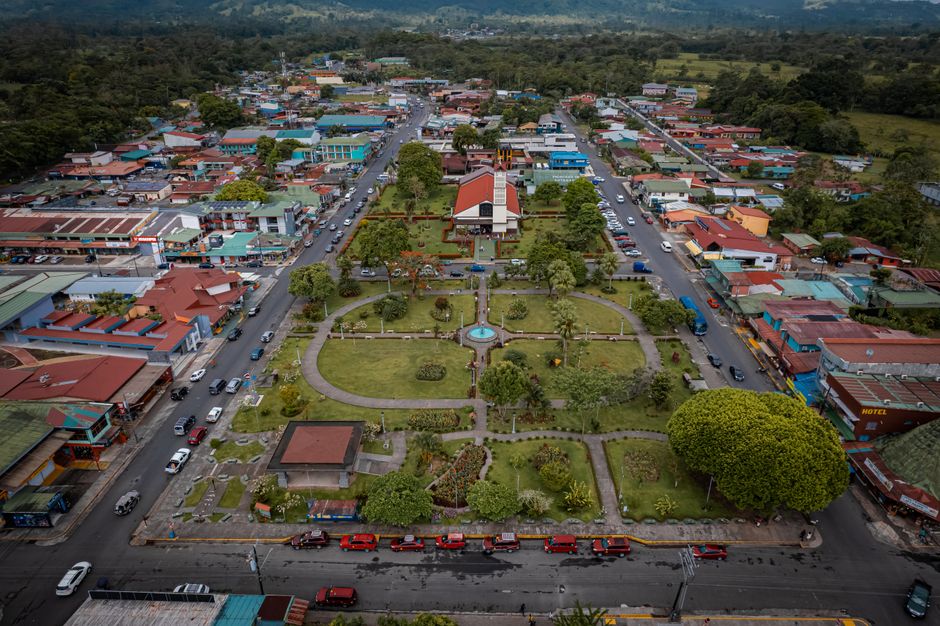
Daily life in Atenas is quiet, structured around the central park and the few main streets that radiate from it. The commercial center is small enough that most residents know the staff at their regular stores by name. Mornings start early — Costa Rican workers and the older expat population are both up early — and most activity wraps up by evening. The town becomes very quiet after dark.
Grocery shopping happens at a small local supermarket and the weekly Friday farmers market that draws produce, local food vendors, and regular socializing from both the Tico and expat communities. For larger purchases, major hardware, or specialized goods, residents drive to Alajuela (about twenty minutes) or San José.
Banking, pharmacies, and routine services are available locally. Internet through fiber providers is reliable in most populated areas of Atenas. Mobile service is stable.
The town's social rhythm is set by the central park, where residents of all kinds converge through the week. Children play. Older residents sit. Families walk. The park is not a tourist attraction — it is what it looks like: the center of a small town's daily life.
The Friday farmers market at the center of town is the week's main social event, drawing locals and expats in a setting that functions as much as a community gathering as a market. Weekend mornings see the most activity; by Sunday afternoon the town is genuinely calm.
The temperate climate shapes how residents live. Without the oppressive heat and humidity of the coast, outdoor daily life is more comfortable year-round. Morning walks, afternoon sitting outdoors, and evening open-air dining are parts of life that the climate makes pleasant in ways the coast cannot match.
- Small commercial core centered on the central park and church plaza
- Friday farmers market is the social and grocery event of the week
- Larger purchases require a drive to Alajuela (~20 minutes) or San José
- Reliable fiber internet in populated areas
- Town becomes very quiet after dark
- Tico and expat communities are integrated rather than segregated in daily life
Climate and Environment
Atenas sits at roughly 700 meters of elevation, which is the single most important fact about the town. That elevation produces a climate consistently milder than the lowlands and the coast — daytime temperatures generally in the 70s and 80s Fahrenheit year-round, nighttime temperatures dropping into the 60s, and humidity meaningfully lower than the coastal towns. The dry-season-to-green-season pattern is the same as the rest of the Central Valley, but the temperatures stay comfortable throughout both.
The town sits in hill country that was historically coffee and sugar-cane farming territory. Surrounding hillsides are a patchwork of coffee farms, sugar cane, mango and citrus orchards, secondary forest, and residential development. The landscape is green most of the year without the dramatic tropical density of the South Pacific coast — more pastoral than jungle.
Wildlife is present but quieter than on the coasts. Birds are the primary draw: Costa Rica's bird diversity reaches into the Central Valley, and Atenas-area birding is rewarding for enthusiasts. Howler monkeys, raccoons, and various reptiles inhabit the area but without the frequency of coastal zones. Venomous snakes exist but are encountered far less often than on the coasts.
Water supply in Atenas is generally reliable, fed by the area's watershed. Power outages happen occasionally, most often during heavy green-season storms, but are less frequent than on the coasts.
The climate's most practical implication: most properties in Atenas do not require air conditioning. This is a meaningful financial and quality-of-life difference from coastal living — windows open, outdoor spaces usable year-round, and electricity bills substantially lower.
- Sits at ~700 meters elevation — milder climate than the coast or lowlands
- Famously moderate year-round temperatures with lower humidity than coastal towns
- Hill country landscape — coffee farms, sugar cane, secondary forest
- Wildlife present but quieter than coastal areas — especially good for birds
- Water supply generally reliable
- Heavy green-season rain can cause road flooding and minor landslides
Cost of Living Reality
Atenas is generally less expensive than the major coastal towns and somewhat less expensive than San José metro for comparable housing. It is not cheap by Costa Rican rural standards, but it offers better value for people seeking comfortable Central Valley living than most other options.
Imported goods carry the same import duties they do everywhere in Costa Rica. Local produce, basic services, and labor are affordable. Restaurants in Atenas are generally modest in price, with a small selection of higher-end places for occasional meals.
Housing varies by location and quality. Older homes in town and modest residential properties cost notably less than equivalent housing in San José metro. Larger hillside properties with views or land carry premiums. Newer gated developments fall in between. Long-term rentals are widely available and reasonably priced; short-term tourist rentals are less common since Atenas is not a tourist destination.
Utilities are typical for Costa Rica. Electricity is among the more expensive in Latin America but bills are lower than coastal towns because most properties don't need air conditioning given the temperate climate — this is one of the meaningful financial advantages of living in Atenas. Internet is competitively priced. Mobile service is competitive.
Vehicle ownership costs apply: marchamo, fuel taxes, maintenance. Rural roads in surrounding areas can accelerate vehicle wear. A vehicle is generally needed in Atenas; the town center is small, but anything beyond requires driving.
The honest answer: Atenas offers some of the best cost-of-living value in expat-friendly Costa Rica, particularly for people whose primary requirement is climate.
- Less expensive than major coastal towns and somewhat less than San José metro
- Most properties don't need AC — significant electricity savings versus coast
- Long-term rentals widely available; short-term tourist rentals less common
- Local produce, basic services, labor all affordable
- Internet and mobile reasonably priced
- Vehicle is generally necessary; rural roads accelerate wear
Healthcare Access
Healthcare access from Atenas is good because of geographic proximity to the Central Valley's medical infrastructure, which is the best in the country.
For routine care, there is a public CAJA clinic in town and several private clinics serving general medical needs. Pharmacies in town fill many medications without prescriptions that would require one elsewhere. For specialist care, residents drive to Alajuela (about twenty minutes), Heredia, or San José metro — all within roughly thirty to fifty minutes — where Costa Rica's major private and public hospitals are concentrated.
Hospital CIMA in Escazú and Hospital Clínica Bíblica in San José are the two most-used private hospitals among the expat community for serious procedures. Both are internationally accredited. Hospital San Juan de Dios and other major public hospitals are also accessible from Atenas.
This is one of the meaningful advantages of Atenas over coastal Costa Rica: medical access is genuinely good. Specialists in any field, advanced imaging, surgical procedures, and emergency care are all within an hour's drive.
Dental care is widely available locally and at higher specialty levels in San José. Costa Rica is a destination for medical and dental tourism, and Atenas residents benefit from that infrastructure.
Health insurance options are the same as elsewhere in Costa Rica — international, private Costa Rican plans, and CAJA enrollment. The combination most retirees use is CAJA enrollment for catastrophic coverage and out-of-pocket private care for routine needs.
- CAJA clinic and private clinics in Atenas for routine care
- Specialist care, advanced procedures, hospitals all within ~30–50 minutes
- Hospital CIMA (Escazú) and Clínica Bíblica (San José) widely used by expats
- Major advantage of Atenas: genuine access to top Costa Rican medical infrastructure
- Pharmacies fill many medications without prescriptions
- Costa Rica's medical and dental tourism infrastructure benefits Atenas residents

Getting Around and Getting Out
Atenas's geography is its single biggest practical advantage: it sits in the western Central Valley with easy access to almost everything that matters in Costa Rica.
The airport — Juan Santamaría International (SJO) — is roughly thirty minutes by car. This is one of the closest expat-popular towns to the airport, which matters meaningfully for retirees with international family or anyone who travels regularly.
San José metro is about fifty minutes east. Alajuela, the second-largest city in the country, is about twenty minutes. Most major shopping, hospitals, government services, and big-box retail are accessible within that distance.
The Pacific coast is accessible. Jacó is about an hour south on the highway. The drive to Manuel Antonio is closer to two and a half hours. Caribbean beaches are roughly five hours east. Many Atenas residents take regular weekend or day trips to the coast, treating Atenas as a permanent base with easy beach access.
Within Atenas, the town center is walkable but spread out enough that most residents drive for daily errands. Hillside properties on rural roads generally need vehicles, and during rainy season some roads become slick or wash out. Four-wheel drive is helpful for some properties but not essential for everyone.
Public bus service connects Atenas to Alajuela, San José, and other Central Valley towns at affordable rates. Buses are reliable and used by a mix of locals and travelers.
Uber operates in the broader Central Valley including Atenas with limited driver availability locally. Local taxis are available; many residents have a few drivers they call directly.
A car is genuinely useful in Atenas, both for local life and to take advantage of the regional access the location provides.
- SJO airport ~30 minutes — one of the closest expat-popular towns to the airport
- Alajuela ~20 minutes; San José metro ~50 minutes
- Pacific coast accessible — Jacó ~1 hour, Manuel Antonio ~2.5 hours
- Caribbean coast ~5 hours east
- 4WD helpful for some hillside properties in rainy season but not always essential
- Public buses, Uber (limited), and local taxis all available

Community and Social Life
Atenas's social life reflects its character: smaller, quieter, and more relational than the bigger towns.
The Costa Rican community has lived here for generations, with the Catholic church, school events, soccer, and family gatherings anchoring local social life. The central park functions as a community gathering space throughout the week, with families, older residents, and casual social activity throughout the day.
The expat community is one of the older established expat populations in Costa Rica outside the major beach towns. Many residents arrived ten, twenty, or thirty years ago when Atenas was even smaller. They are heavily weighted toward retirees, but include families, working professionals, and remote workers as well. The community is not as large as Tamarindo or Escazú but is meaningfully integrated and active.
Gathering points include the Friday farmers market, which is the central weekly social event for both locals and expats. Several cafes and restaurants in town function as informal meeting spots. Volunteer organizations, hiking groups, and social clubs run by long-term residents provide entry points for newcomers. The expat community has a reputation for being welcoming to new arrivals — partly because the smaller scale means most residents understand the value of integrating new people, partly because the community has been around long enough to have developed those habits.
Religious community is mostly Catholic with smaller evangelical and other Christian fellowships. Some non-Christian communities and groups exist but are smaller.
Making friends in Atenas as an adult is generally easier than in larger places because the social circles are smaller and more interconnected. People who put themselves in regular gathering spaces and show up consistently tend to find their community within months.
- Smaller, more relational social scene than larger Central Valley cities
- Friday farmers market is the central weekly social event
- One of the older established expat communities in Costa Rica
- Heavily weighted toward retirees but includes families and remote workers
- Volunteer groups, hiking groups, and social clubs offer entry points for newcomers
- Spanish proficiency meaningfully expands social access to the Tico community

Schools and Family Life
Families do raise children in Atenas, and the Central Valley offers more educational options than coastal towns.
For Costa Rican families, the public school system serves Atenas with primary and secondary schools. Costa Rica's public education system is generally functional, and Atenas's local schools have a community-oriented character. Many Costa Rican parents who can afford private education send their children to private schools in Atenas, Alajuela, or San José.
For expat families, private and bilingual school options expand significantly because of proximity to the Central Valley. Several private schools serve the Atenas area, and a much wider range of bilingual and international schools is accessible within a thirty-to-forty-five-minute drive in Alajuela, Heredia, San José, and Escazú. Some of the country's most established international schools — including those that prepare students for North American or European universities — are within commuting distance.
Costa Rica is generally safe and welcoming for children. Kids walk and bike around Atenas more freely than they would in most North American cities. The natural environment is part of childhood — hiking, exploring, and outdoor activities are normal. Pediatric healthcare is available locally for routine matters and at the highest specialty level in San José.
Activities for children include soccer, music, dance, art, and a range of school-based and independent programs. The Central Valley offers more variety than coastal towns. The temperate climate means outdoor activities are pleasant year-round, which matters for kids who don't tolerate extreme heat.
The honest considerations: Atenas itself has limited bilingual school options compared to larger Central Valley cities, so expat families often commit to a daily commute for school. Specialized educational support is more accessible from Atenas than from coastal towns. Healthcare for serious pediatric issues is genuinely accessible within an hour.
- Public schools available in Atenas; private schools in town and region
- Wide range of bilingual and international schools within 30–45 minute commute
- Some of Costa Rica's most established international schools accessible from Atenas
- Temperate climate means outdoor childhood activities are pleasant year-round
- Specialized educational support more accessible than from coastal towns
- Healthcare for serious pediatric issues genuinely accessible
Working and Income
Atenas's location creates more income options than most Costa Rican expat towns because of Central Valley access.
For people working remotely for foreign employers, Atenas is excellent. Internet through fiber providers is reliable for remote work. The temperate climate means home offices are pleasant year-round without needing aggressive air conditioning. Coworking spaces are smaller than in Tamarindo or San José but exist. Time zone aligns with North America.
For people seeking employment in Costa Rica, the Central Valley access matters. Atenas itself has limited local employment, but many residents commute to jobs in Alajuela, Heredia, or San José metro — the country's main employment center. Foreigners working in Costa Rica need appropriate residency status and work authorization.
For entrepreneurs, Atenas offers a small but real local market plus easy access to the Central Valley's larger commercial activity. Some long-running expat-owned businesses in Atenas have served the local community for years; others have come and gone. The retiree-heavy expat community is a stable customer base for certain types of businesses but limits the addressable market for others.
For Costa Ricans, Atenas employment includes local services, agriculture, education, and commuting jobs in the broader Central Valley. The income mix is more stable than tourist-economy coastal towns.
Real estate income exists but Atenas is not a vacation rental town. Long-term rentals to Costa Rican families and to expat residents are the more common pattern; short-term tourist rentals are uncommon.
- Excellent for remote work — reliable fiber, temperate climate, good time zone
- Central Valley commute opens employment options not available in coastal towns
- Small but real local market for entrepreneurs serving the expat retiree community
- More stable income mix for Ticos than tourist-economy coastal towns
- Long-term rentals more common than vacation rentals
- Time zone aligns with North American work schedules

Safety and Honest Concerns
Atenas is generally considered one of the safer towns in Costa Rica, both by Costa Ricans and by long-term expats. The size, the residential character, and the integration of local and expat communities all contribute to a daily life that feels more secure than most.
Petty crime exists. Theft from unlocked vehicles, opportunistic break-ins, and pickpocketing in busier areas all happen, particularly during the holiday season when more visitors come through. Basic precautions reduce these risks.
Violent crime is genuinely uncommon in Atenas. The town's small size and community character make random street violence very rare. Most violent crime in Costa Rica is concentrated in specific zones of San José metro, the major coastal cities, and the borders.
The drug economy that affects parts of the Pacific coast is much less of a presence in Atenas. The town's location away from major trafficking routes and its smaller scale keep it largely insulated.
Natural hazards are mostly weather-related. Heavy green-season rains can cause flooding on local roads, occasional landslides on steep hillside roads, and brief road closures. Earthquakes are part of life in Costa Rica; Atenas is no more or less affected than the rest of the country.
Fire risk is generally low compared to the dry tropical zones, though dry-season grass fires happen.
The biggest practical safety consideration for many residents is winding rural roads. Some hillside properties access via narrow, steep roads that are challenging in poor weather. Verifying access in green season before buying or renting matters.
The honest takeaway: Atenas is among the safer choices in Costa Rica. The combination of small-town character, Central Valley location, and established expat community produces a daily life with low crime and predictable rhythms.
- Generally considered one of the safer towns in Costa Rica
- Petty theft exists; basic precautions reduce risk substantially
- Violent crime genuinely uncommon
- Drug economy affects this region much less than the Pacific coast
- Heavy green-season rains can cause local flooding and minor landslides
- Verify hillside road access during green season before committing to a property
The Hard Truths
Atenas has fewer hard truths than many Costa Rican towns, but the ones that apply matter.
The town is genuinely small. People who need a wide social menu, varied entertainment, regular nightlife, or anonymous urban energy will not find that here. Some people romanticize small-town life and then discover they need more stimulation than a small town offers. The expat community is established and welcoming, but it is not dense.
It is not a beach town. People who imagine waking up to ocean views or walking to surf breaks should choose elsewhere. The Pacific is an hour away; close enough for regular trips, far enough that beach life is not daily life.
The climate's reputation creates expectations. Atenas's climate is genuinely temperate compared to lowland Costa Rica, but it is not the eternal-spring fantasy some marketing suggests. There are still warm afternoons in dry season, cool wet evenings in green season, and the tropical sun is intense at this elevation. People expecting Mediterranean climate will be slightly disappointed.
Tico time applies. Government bureaucracy, contractor scheduling, package delivery, and most service work move at a pace that frustrates people from efficient cultures. This is not specific to Atenas — it is Costa Rican daily life — but newcomers consistently underestimate it.
Language matters. The expat community is large enough that you can survive in English, but you stay in a smaller version of Atenas if you do. The Tico community is the foundation, and Spanish proficiency expands your access meaningfully.
Bureaucracy is a parallel reality that residents cannot escape. Establishing residency, registering vehicles, opening bank accounts, paying property taxes, and most other administrative work involves processes that feel slow and inconsistent. Lawyers and gestores are part of the cost of being here.
Some hillside properties are challenging to maintain. Access in green season, road conditions, and the construction demands of a hilly environment are ongoing costs that buyers often underestimate.
- Genuinely small town — limited entertainment, dining, social menu
- Not a beach town — coast is an hour away
- Climate is temperate but not Mediterranean — tropical sun still intense
- Tico time applies; bureaucracy slow; Spanish meaningfully expands access
- Hillside properties have ongoing maintenance demands and access challenges
- Real estate market smaller and less liquid than larger Costa Rican markets
- Vacation rental income limited — Atenas is not a tourist destination
- Loneliness real for retirees who isolate; community requires showing up
Frequently Asked Questions About Living in Atenas
Is Atenas safe for foreigners to live in?
Atenas is generally considered one of the safer towns in Costa Rica, both by Costa Ricans and by long-term expats.
How much does it cost to live in Atenas?
Atenas is generally less expensive than the major coastal towns and somewhat less expensive than San José metro for comparable housing.
Do I need to speak Spanish to live in Atenas?
Atenas's social life reflects its character: smaller, quieter, and more relational than the bigger towns.
What is the best time of year to visit Atenas?
Atenas sits at roughly 700 meters of elevation, which is the single most important fact about the town.
Quick Reference: Atenas At a Glance
| Overview | Atenas sits in the hills west of San José, roughly thirty minutes from the international airport, with a small-town feel and a climate that consistently gets called the best in the country. |
| Climate | Atenas sits at roughly 700 meters of elevation, which is the single most important fact about the town. |
| Real estate | Atenas offers a mix of older Costa Rican homes in town, larger residential properties in surrounding hills, and newer gated developments — generally at lower price points than San José metro for comparable comfort. |
| Time zone | CST (UTC−6) — no daylight saving time |
| Nearest airport | SJO — Juan Santamaría International Airport |
| Foreign ownership | Yes — foreigners own fee-simple title with the same rights as Costa Rican nationals |
Pros and Cons
Advantages
- ✓ Famously temperate climate — moderate temperatures year-round
- ✓ Thirty minutes from SJO international airport
- ✓ Smaller, quieter alternative to San José metro
- ✓ Established expat community with multiple service providers
Considerations
- ! Inland location — beach access requires drive of an hour or more
- ! Smaller commercial base than larger Central Valley towns
- ! Limited specialist medical services locally
- ! Some hillside properties require 4WD in rainy season
Practical Notes
Atenas is part of the western Central Valley, with Grecia and Sarchí to the north, San Mateo and the coastal route to the southwest. Many residents use Atenas as a base for both Central Valley life and easy weekend coast access.
Nearby Areas to Compare
Ready to Compare Properties in Atenas?
Browse verified broker listings from Atenas and the surrounding area.