Nicoya Peninsula · Guanacaste · Costa Rica
What Is Life in Sámara, Costa Rica Like?
Sámara is a small, family-friendly beach town on the Nicoya Peninsula known for one of the calmest swimmable beaches on the Pacific coast and a quieter, more local character than the major Guanacaste destinations.

What Sámara Actually Is
Sámara is a small beach town on the southern Nicoya Peninsula in Costa Rica's Guanacaste province. It sits along a wide, sheltered bay protected by a reef offshore, which produces one of the calmest swimmable beaches on the Pacific coast — a meaningful distinction in a country where most Pacific beaches have currents and surf strong enough to be genuinely dangerous.
What Sámara is not: a large, busy destination with major resort infrastructure, a surf hub, or a place with the commercial density of Tamarindo or the international reputation of Nosara. The town center is small, the pace is slow, and most evenings are quiet.
What Sámara is: a genuinely family-friendly beach town with an established Costa Rican community, a long-standing international expat presence (Italian, American, Canadian), several private schools with multi-decade track records, and a beach that parents consistently describe as one of the few Pacific options where they feel comfortable letting children play in the water.
Sámara sits on the southern portion of the Nicoya Peninsula, in Nicoya canton. Carrillo, a quieter beach, sits fifteen minutes to the south. Nosara, the more internationally prominent yoga and surf destination, is about forty-five minutes to the north. The town is its own region — getting in and out follows the peninsula's road network rather than the main Pacific Costanera Sur.
The expat population has Italian roots that go back to the 1980s, which gives Sámara's dining scene an unusually good Italian restaurant tradition alongside the standard Tico sodas and international spots.
- Located in Nicoya canton, Guanacaste province, southern Nicoya Peninsula
- Reef-sheltered bay produces unusually calm beach safe for swimming
- Long-standing Italian, American, and Canadian expat presence
- Smaller and quieter than Tamarindo or other major Guanacaste destinations
- Liberia airport is roughly 2.5 hours by road; longer access than Gold Coast towns
What Daily Life Looks Like
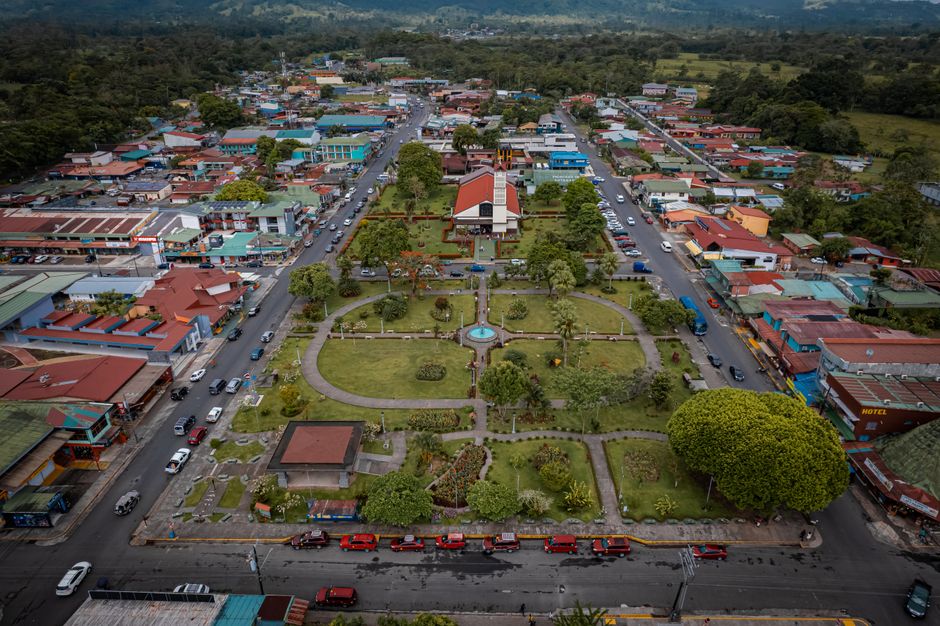
Daily life in Sámara is structured around the beach, the small commercial center, and the residential areas spreading back from the coast. The town is small enough that residents know each other on sight after a few weeks. The pace is slower than Tamarindo or Jacó, and noticeably slower than San José or any inland city.
For groceries, there is a small Super Compro and several local supermarkets covering basics. The weekly farmers market draws produce, fish, and a social gathering of the broader community. For larger purchases, residents drive to Nicoya (about an hour inland) or accept the trip to Liberia for big-box shopping.
Banking and pharmacies are available in town. Medical clinics handle routine care. Fiber internet reaches the populated areas. The commercial base is small — a handful of hardware stores, services, and specialty shops — with the understanding that anything beyond basics means driving.
The dining scene is active relative to the town's size. Long-running Italian restaurants, local sodas, and international spots give Sámara a food scene that punches above its weight. Sunday markets and beach gatherings shape the weekly social rhythm.
The town is walkable from the center to the beach. Many residents use bicycles — the geography is flatter than the South Pacific beach towns, which makes biking genuinely practical. Outlying residential areas and hillside properties require vehicles.
- Small Super Compro and local markets cover daily groceries
- Larger purchases require trip to Nicoya (~1 hour) or Liberia (2+ hours)
- Banking, pharmacies, fiber internet all available locally
- Sundays feel distinctly local; weekend Costa Rican tourism meaningful but not overwhelming
- Long-standing Italian community shapes the dining scene
- Pace is slower than Tamarindo or Jacó
Climate and Environment
Sámara has a dry tropical climate similar to the rest of Guanacaste — meaningfully drier than the southern Pacific or Caribbean coasts, with a distinct dry season that turns the landscape brown and gold. The dry season runs December through April, with months sometimes passing without significant rain. The green season runs May through November, bringing afternoon storms but rarely the all-day downpours common further south.
Heat is constant. Daytime temperatures during dry season regularly reach 35°C (95°F) and above. The wind — called the Papagayo — blows consistently and strongly from the north during the dry season, which provides some cooling but can also be intense enough to affect outdoor activities and sleep for weeks at a time. Air conditioning is used widely in bedrooms.
The bay itself is the defining environmental feature. Protected by an offshore reef, the water inside the bay stays calm enough for family swimming in most conditions — an unusual characteristic on a coast known for its surf and currents. Outside the bay or at specific river mouths, standard Pacific currents apply.
Wildlife is dry tropical forest species: howler monkeys, white-faced capuchins, iguanas, parakeets, and a variety of shore birds. Sea turtle nesting happens on nearby beaches seasonally. The landscape is more arid than the South Pacific — beautiful in a different way, with dry forest, rocky outcrops, and golden-brown hillsides during peak dry season.
Water supply is a real concern in Guanacaste broadly. During the driest months, properties on wells can experience stress. Water conservation is part of daily practice.
- Dry tropical climate; driest region in Costa Rica
- Reef-protected bay produces unusually calm beach water
- Sustained northerly winds during dry season affect daily life
- Dry tropical forest wildlife — howler monkeys, iguanas, capuchins, parakeets
- Bay swim conditions much safer than typical Pacific beaches
- Water conservation matters during driest months
Cost of Living Reality
Sámara is generally less expensive than Tamarindo, comparable to or slightly less than Nosara, and somewhat less expensive than Manuel Antonio for comparable property quality. Cost varies significantly with whether you live local or attempt a foreign lifestyle.
Imported goods carry standard import duties. Local produce, fish, basic services, and labor are affordable. Restaurants in Sámara range from inexpensive sodas to higher-end places that have been serving the international community for decades — eating out at the better restaurants is an expense, while everyday meals are reasonable.
Housing varies by location. Beach-adjacent properties carry premiums; residential areas behind town are more affordable. Hillside ocean-view properties exist but Sámara has fewer dramatic hillside developments than the South Pacific. Long-term rentals are widely available and meaningfully cheaper during green season.
Utilities are typical for coastal Guanacaste. Electricity is expensive and AC bills accumulate during the hot months. Water is generally affordable but can be tight during the driest months. Internet is competitively priced. Mobile service is competitive.
Vehicle ownership costs apply. Most properties beyond the immediate town center benefit from a vehicle, though some residents in town manage with bicycles and walking. Rural roads to outlying properties accelerate vehicle wear.
The honest answer: Sámara offers reasonable cost-of-living value for an established Guanacaste beach town, particularly for people who want a calm beach and don't need the infrastructure scale of Tamarindo. The Guanacaste-specific costs (electricity, water in dry season) apply.
- Generally less expensive than Tamarindo; comparable to or slightly less than Nosara
- Beach-adjacent properties carry premiums; residential areas more affordable
- Long-term rentals widely available and cheaper in green season
- Electricity expensive; AC bills meaningful in hot months
- Water can be tight during driest months — Guanacaste-specific concern
- Some town residents manage with bicycles; outlying properties need vehicles
Healthcare Access
Healthcare from Sámara depends on local clinics for routine care and travel for specialists.
For routine care, there are private clinics in Sámara serving general medical needs. Pharmacies in town fill many medications without prescriptions that would require one elsewhere. The CAJA system has presence locally for residents enrolled in the public system.
For specialist care, residents drive to Nicoya (about an hour inland), Liberia (two-plus hours), or San José metro for more advanced treatment. Hospital CIMA in Escazú and Hospital Clínica Bíblica in San José are the most-used private hospitals among the international expat community for serious procedures. Both are internationally accredited.
For emergencies, the nearest larger public hospital is in Nicoya. Air ambulance services exist for very serious cases.
Dental care is available locally for routine work; more involved procedures typically happen in Nicoya, Liberia, or San José. Costa Rica's medical and dental tourism infrastructure is accessible to Sámara residents who travel to the Central Valley for specific procedures.
Health insurance options are the same as elsewhere in Costa Rica — international, private Costa Rican plans, or CAJA enrollment. Many residents combine CAJA for catastrophic coverage with out-of-pocket private care for routine needs.
The trade-off: Sámara's healthcare follows the pattern of smaller Costa Rican beach towns — routine care available, specialists requiring travel. People who require frequent specialist visits typically live elsewhere or accept regular travel.
- Private clinics in Sámara for routine care; CAJA presence locally
- Specialist care: Nicoya (~1 hour), Liberia (2+ hours), San José (~5 hours)
- Public hospital in Nicoya serves the southern peninsula
- Hospital CIMA and Clínica Bíblica in San José for serious procedures
- Pharmacies dispense many medications without prescriptions
- Geographic remoteness means specialist care requires travel

Getting Around and Getting Out
Inside Sámara, the town center is walkable, and many residents use bicycles for daily movement. The geography is flatter than the South Pacific beach towns, which makes biking practical. Outlying residential areas and properties up surrounding hills generally require vehicles.
For getting out, the relevant airport is Daniel Oduber International (LIR) in Liberia, roughly two and a half hours by road. Juan Santamaría (SJO) in San José is about five hours away. For residents who travel often, the longer drive to LIR is meaningful; some use the small domestic airport at Carrillo with flights to San José as an alternative.
The main road network has improved over the past decade but the Nicoya peninsula's roads are generally rougher and more rural than the Costanera Sur on the Pacific. Some routes from Sámara to other peninsula towns or out to the main highways involve gravel sections that turn slick in green season.
Driving north reaches Nosara in about forty-five minutes. Driving south reaches Carrillo in fifteen minutes. Driving inland reaches Nicoya, the canton seat, in about an hour. The route to Liberia and the airport involves the Tempisque bridge or — historically — the ferry at Puntarenas.
Public bus service connects Sámara to Nicoya, San José, and other towns at affordable rates. Schedules require local confirmation; service is less frequent than in larger towns.
Uber operates in some parts of Guanacaste with limited driver availability in Sámara itself. Local taxis are available; many residents have a few drivers they call directly.
A vehicle is genuinely useful in Sámara, particularly for the regional access the location provides. Going without one is possible if you live in town and accept geographic constraints.
- Town center walkable; bicycles practical due to flatter geography
- LIR airport ~2.5 hours; SJO airport ~5 hours
- Small domestic airport at Carrillo serves flights to San José
- Nicoya peninsula roads rougher than the main Pacific coastal highway
- Public buses reliable but less frequent than in larger towns
- A vehicle is useful for regional access; not strictly required for in-town life

Community and Social Life
Sámara's social life is small, multilayered, and shaped by decades of international expat presence alongside a stable Costa Rican community.
The Costa Rican community is the foundation. Many local families have lived here for generations. Soccer, the Catholic church, school events, and family gatherings anchor local social life. The town has a strong civic identity tied to its long history as a fishing community before it became a destination.
The expat community is established but not as large as Tamarindo's. The Italian community has had particular long-standing presence, with families that arrived in the 1980s and 1990s and have raised children here. Americans, Canadians, and other Europeans round out the international population. Long-term residents are deeply integrated with the local community in ways that distinguish Sámara from places where expat populations remain more separate.
Gathering points include the bay-front beach at sunset (a daily social ritual), several long-running cafes and restaurants that function as community living rooms, the weekly farmers market, and yoga and wellness studios. The dining scene is active — Italian restaurants in particular have been serving the community for decades and serve as social hubs.
Religious community is mostly Catholic among Costa Ricans, with a smaller and more varied religious mix among expats. Volunteer work tied to community organizations and turtle nesting (in nearby beaches) gives newcomers entry points.
Making friends in Sámara as an adult is generally easier than in larger places because the small scale and stable resident population make repeated encounters routine. The community has a reputation for being welcoming. Spanish proficiency expands access to the Tico community and to social interactions that don't filter through English. The Italian community provides another social layer for those connected to it.
- Stable Tico community deeply integrated with established expat population
- Long-standing Italian community is a distinctive social layer
- Bay-front sunset is a daily social ritual
- Weekly farmers market is a regional social event
- Italian restaurants and long-running cafes function as community hubs
- Spanish proficiency expands access to Tico community and broader social interactions

Schools and Family Life
Sámara is a strong location for families with young children, partly because of the safe swim beach and partly because of the established expat community with multi-generational presence.
For Costa Rican families, the public school system serves Sámara and surrounding areas with primary and secondary schools. Many Costa Rican parents who can afford private education send their children to private schools in Sámara, Nicoya, or further afield.
For expat families, private and bilingual school options in Sámara itself include several private schools, some with multi-decade track records serving the international community. The school options here are more developed than in many smaller Costa Rican beach towns. International school options expand if families are willing to commit to longer commutes — Liberia and the Central Valley both have additional choices accessible to families willing to travel.
Costa Rica is generally safe and welcoming for children. The bay-front beach is one of the few Pacific beaches where parents can let young children swim without constant high-alert supervision. Outdoor freedom is significant. Pediatric healthcare is available locally for routine matters and at higher levels in Nicoya, Liberia, or San José.
Activities for children include surf lessons (gentler than other Pacific spots, ideal for beginners), soccer, music, art, and a range of structured after-school programs. The natural environment is part of childhood — the beach, the dry forest, and nearby wildlife are normal parts of growing up here.
The honest considerations: school options are more developed than in smaller beach towns but more limited than in major Central Valley cities. Bilingual or full-immersion Spanish education is the practical default. Specialized educational support typically requires travel. Healthcare for serious pediatric issues will likely involve trips to Nicoya, Liberia, or San José.
For families with young children specifically choosing for a safe swim beach and a settled community, Sámara is genuinely one of the stronger options on the Pacific coast.
- Strong location for young families — safe swim beach, established expat community
- Private and bilingual schools more developed than smaller beach towns
- Bay swim safety distinguishes Sámara from most Pacific options
- Surf lessons gentler than other Pacific spots — ideal for kid beginners
- Specialized education and pediatric specialists require travel
- Touring schools in person before committing remains essential
Working and Income
Income strategies in Sámara mirror other Costa Rican beach towns: remote work for foreign employers is the most common viable path; local employment is limited; entrepreneurship is real but demanding.
For remote workers, Sámara is viable. Internet through fiber providers reaches most populated areas with reliability sufficient for video calls and standard remote work. The time zone aligns with North America. Coworking spaces are smaller and fewer than in Tamarindo but exist.
For local employment, options center on tourism, hospitality, real estate, restaurants, and trades. Foreigners need appropriate residency status and work authorization. Pay scales reflect the Costa Rican economy.
For entrepreneurs, Sámara's stable expat-and-tico community supports particular kinds of businesses — restaurants, accommodations, surf and yoga schools, services oriented toward the residential community. Several long-running expat-owned businesses have served Sámara for decades. The smaller market is both a constraint and an opportunity.
For Costa Ricans, employment in Sámara includes hospitality, agriculture, fishing, trades, and increasingly services tied to the residential expat population. The labor market is somewhat more stable than purely tourist-driven destinations because of the stable resident population.
Vacation rental income exists in Sámara. The market is meaningful but smaller than Tamarindo or Manuel Antonio, with seasonal patterns following Costa Rican holiday weekends as much as international tourism. Owners who manage well can generate income; passive-income expectations are often disappointed.
- Remote work for foreign employers most common viable income path
- Reliable fiber internet; smaller coworking presence than Tamarindo
- Local employment limited; pay reflects Costa Rican economy
- Stable resident community supports certain entrepreneurship niches
- Vacation rental market smaller than Tamarindo or Manuel Antonio
- Time zone aligns with North American work schedules

Safety and Honest Concerns
Sámara is generally considered safer than the major Costa Rican beach destinations, both by Costa Ricans and by long-term expats. The smaller scale, the residential character, and the integration of local and expat communities all contribute to a daily life that feels more secure.
Petty crime exists. Theft from unlocked vehicles, opportunistic break-ins, and pickpocketing all happen, particularly during high season when more visitors come through. Basic precautions reduce these risks substantially.
Violent crime is uncommon in Sámara's daily life. The town's smaller scale and the geography keep it largely insulated from the patterns affecting the major coastal destinations. Most violent crime in Guanacaste is concentrated in specific zones of Liberia and along certain routes, not in residential beach towns of Sámara's character.
The drug economy that affects parts of the Costa Rican coast has less presence in Sámara than in the major destinations. Most residents never encounter it directly.
Beach safety is a meaningful local concern, but the bay protection makes Sámara unusually safe relative to other Pacific beaches. Within the bay, swimming is generally safe in calm conditions. Outside the bay or at certain river mouth areas, currents apply normally and respect for ocean conditions still matters.
Wildlife concerns include venomous snakes (uncommon encounters but real), crocodiles in local rivers and estuaries, scorpions occasionally in homes, and the standard tropical insect background.
Weather hazards include green-season flooding, occasional landslides on rural roads, and the rare tropical storm impact. Earthquakes are part of life in Costa Rica.
Water scarcity during the driest months is a real concern in Guanacaste broadly and in Sámara specifically. Properties on wells can experience stress during long dry seasons.
The honest takeaway: Sámara is among the safer beach options in Costa Rica, with the bay-protected swimming a genuine safety advantage for families. Standard precautions apply; no location is without risk.
- Generally considered safer than major Costa Rican beach destinations
- Petty theft most common issue; basic precautions reduce risk
- Violent crime uncommon in daily life
- Bay-protected swimming distinguishes Sámara from most Pacific beaches
- Crocodiles in local rivers and estuaries — warning signs are real
- Water scarcity during driest months is a real Guanacaste-wide concern
The Hard Truths
Sámara has fewer hard truths than larger Costa Rican beach towns, but the ones that apply matter.
The heat is intense. Dry-season temperatures are hot, the sun is unrelenting, and acclimation takes most newcomers longer than they expect. People who do not function well in heat will struggle even in Sámara's relatively pleasant setting.
Water is a real concern during the driest months. Guanacaste is the driest region of Costa Rica, and Sámara's smaller infrastructure means properties on wells can experience stress. Conservation is part of daily life during the dry season.
Wind matters. The dry-season winds are sustained and can be intense. Some residents in exposed homes find them disruptive to sleep and outdoor activities for weeks at a time.
Geographic remoteness is a real factor. The drive to LIR airport is meaningful — two and a half hours each way — and the longer trip to SJO means residents who travel often plan for it. Specific products, big-box retail, and many services involve travel to Nicoya, Liberia, or further.
The pace is slower than most newcomers expect. Tico time applies fully. People requiring service efficiency from a North American or European frame of reference will be repeatedly frustrated.
Language matters. The expat community is established but smaller than Tamarindo's, and Spanish proficiency expands meaningful access to the Tico community. Without Spanish, daily interactions and friendships will be more limited.
Bureaucracy is the same as elsewhere in Costa Rica — slow and inconsistent. Lawyers and gestores are part of normal expense.
Coastal climate is hard on construction. Salt air, humidity (less here than the South Pacific but still real), heat, UV, and insects degrade buildings continuously.
The town is genuinely small. People who need a wide social menu, varied entertainment every night, or urban energy will not find it here. Some thrive in this; others find it constraining.
Real estate returns are not guaranteed. The Sámara market is smaller and less liquid than Tamarindo, and appreciation projections from people earning commissions should be discounted.
- Dry-season heat intense; some never fully acclimate
- Water scarcity during driest months is real concern
- Sustained dry-season winds disruptive in exposed homes
- Geographic remoteness — LIR is 2.5 hours, SJO is 5
- Tico time applies fully; bureaucracy slow
- Spanish proficiency expands community access meaningfully
- Small town — limited social menu, dining variety, entertainment
- Real estate market smaller and less liquid than Tamarindo
Frequently Asked Questions About Living in Sámara
Is Sámara safe for foreigners to live in?
Sámara is generally considered safer than the major Costa Rican beach destinations, both by Costa Ricans and by long-term expats.
How much does it cost to live in Sámara?
Sámara is generally less expensive than Tamarindo, comparable to or slightly less than Nosara, and somewhat less expensive than Manuel Antonio for comparable property quality.
Do I need to speak Spanish to live in Sámara?
Sámara's social life is small, multilayered, and shaped by decades of international expat presence alongside a stable Costa Rican community.
What is the best time of year to visit Sámara?
Sámara has a dry tropical climate similar to the rest of Guanacaste — meaningfully drier than the southern Pacific or Caribbean coasts, with a distinct dry season that turns the landscape brown and gold.
Quick Reference: Sámara At a Glance
| Overview | Sámara sits along a sheltered bay on the southern Nicoya Peninsula, with a relaxed pace, an established but not overwhelming expat community, and a beach that locals consider one of the safest in Costa Rica for swimming with kids. |
| Climate | Sámara has a dry tropical climate similar to the rest of Guanacaste — meaningfully drier than the southern Pacific or Caribbean coasts, with a distinct dry season that turns the landscape brown and gold. |
| Real estate | Sámara offers beach-adjacent residential properties, modest condos, hillside homes with ocean views, and inland properties — generally at lower price points than Tamarindo for comparable proximity to the beach. |
| Time zone | CST (UTC−6) — no daylight saving time |
| Nearest airport | LIR — Liberia International Airport |
| Foreign ownership | Yes — foreigners own fee-simple title with the same rights as Costa Rican nationals |
Pros and Cons
Advantages
- ✓ Calm bay-protected beach safe for swimming and family use
- ✓ Smaller and quieter than major Guanacaste destinations
- ✓ Established expat community with multiple service providers
- ✓ Lower property prices than Tamarindo for comparable beach access
Considerations
- ! Smaller commercial base than larger beach towns
- ! Liberia airport is two-plus hours; access takes longer than Gold Coast towns
- ! Dry tropical climate with intense dry-season heat
- ! Limited specialist healthcare locally
Practical Notes
Sámara is part of the southern Nicoya peninsula with Carrillo just to the south and Nosara about 45 minutes north. The peninsula is its own region rather than a Gold Coast extension; getting in and out follows different patterns.
Nearby Areas to Compare
Ready to Compare Properties in Sámara?
Browse verified broker listings from Sámara and the surrounding area.